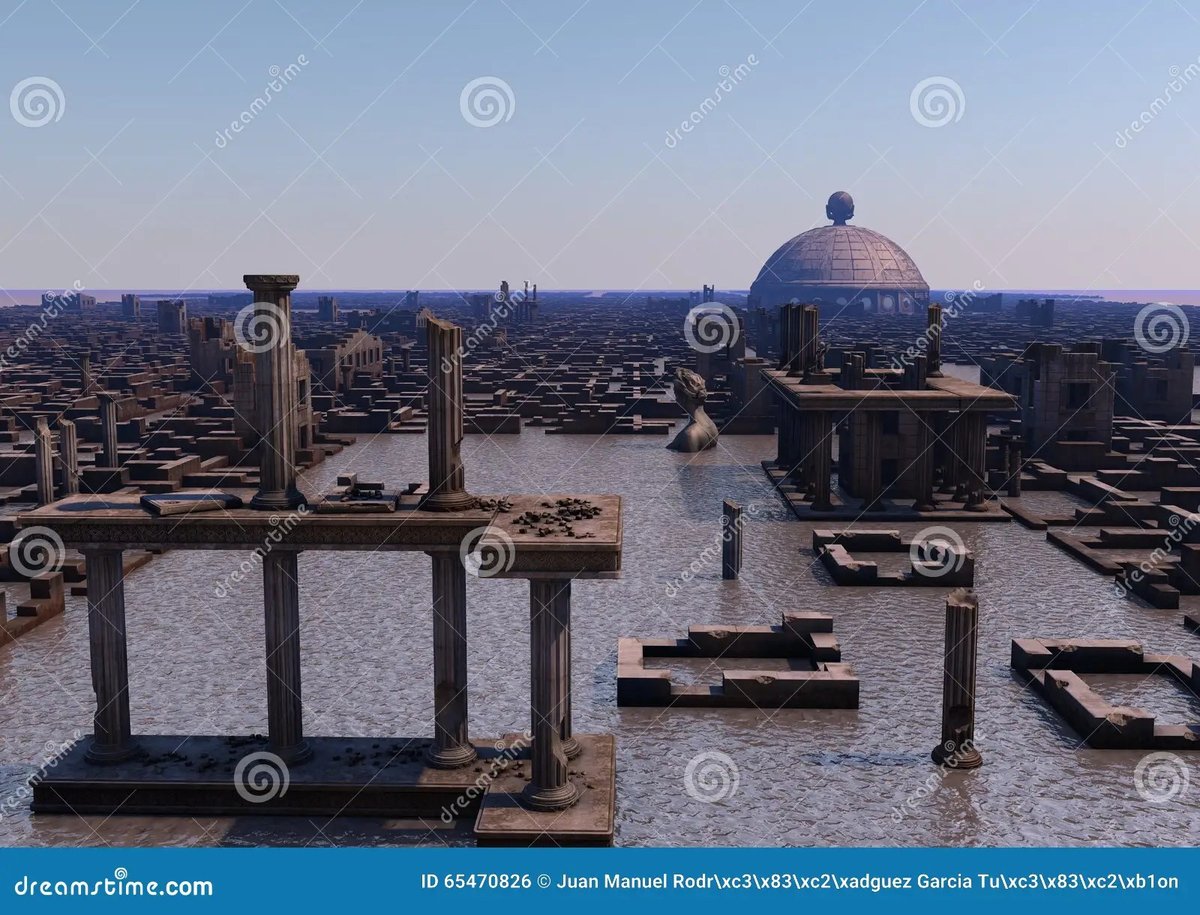
Mention Atlantis, and images flood the mind: an iridescent city beneath the waves, glowing crystals powering futuristic devices, a utopia of advanced technology and serene, wise inhabitants. This vivid picture of an impossibly advanced civilization, tragically lost to the sea, is deeply ingrained in our collective imagination. But what if the source of this legendary society — the philosopher Plato — described something far different? What if the "advanced technology" wasn't flying cars or energy crystals, but merely the pinnacle of ancient engineering?
It’s time to separate the facts from the fantastical overlay built up over millennia. Our journey will dive deep into Plato's original accounts, explore the technologies he actually described, trace how the myth morphed into its modern, sci-fi grandeur, and uncover the ongoing scientific quest for its elusive remains.
At a Glance: Unpacking Atlantis's True Legacy
- Plato is the Source: All primary information about Atlantis comes from Plato's dialogues Timaeus and Critias, written around 360 BC.
- Ancient, Not Sci-Fi: Plato described Atlantis as an ancient society, 9,000 years before his time, with technologies fitting the Hellenic world (e.g., triremes, complex architecture).
- No Crystal Tech: Plato never mentioned magical crystals, advanced energy sources, flying machines, or other sci-fi elements commonly associated with Atlantis today.
- Moral Downfall: Atlantis fell not due to technological hubris, but because its divine bloodline became diluted by mixing with mortals, leading to moral corruption and divine wrath.
- Modern Myth-Making: The idea of Atlantis as a super-advanced civilization with mystical powers emerged long after Plato, fueled by misinterpretations, exaggerations, and pure imagination.
- Scientific Skepticism: Despite ongoing searches, there is no credible geological or archaeological evidence to support the physical existence of Atlantis or its purported advanced technology.
- Cultural Power: Atlantis endures as a powerful symbol in literature, film, and games, representing lost knowledge, hidden truths, and humanity's fascination with ancient mysteries.
Plato's Atlantis: A City Built on Grandeur, Not Gadgets
To truly understand Atlantis, we must go back to its origin: the eloquent words of Plato. Far from a hidden manuscript or a rediscovered artifact, Atlantis's entire story begins and largely ends with two of his most profound dialogues.
The Original Storyteller: Who Was Plato?
Plato, a titan of ancient Greek philosophy (circa 428–348 BC), gave us ideas that shaped Western thought for millennia. In his works Timaeus and Critias, he introduces Atlantis not as a historical account but as a narrative device within a philosophical discourse. It served as a cautionary tale, meant to illustrate the ideal state (represented by ancient Athens) in contrast to an imperialistic, corrupt power (Atlantis). This context is crucial; Plato's primary goal was philosophical, not historical chronicling.
Beyond the Pillars: Setting the Scene for a Lost World
Plato describes Atlantis as a powerful island nation, situated "beyond the Pillars of Hercules" (thought to be the Strait of Gibraltar), existing approximately 9,000 years before his own time. This places its flourishing around 9,600 BC – a period we now understand as the Stone Age, long before the rise of sophisticated urban centers we associate with ancient civilizations. This temporal gap is a key source of later misinterpretations, as what was "advanced" in 9,600 BC would be vastly different from what was "advanced" in Plato's era, let alone ours.
An Architect's Dream: Concentric Rings and Engineering Feats
Plato's description of the Atlantean capital is breathtaking, a true marvel of ancient engineering and urban planning. Imagine a central island, home to the royal family, surrounded by alternating rings of land and water. These rings were not merely natural formations; they were meticulously crafted, bridged, paved, and connected to the open sea by a grand canal.
Triremes, the formidable warships of the ancient world, could sail directly to the central island through carefully excavated cuts in the mountainous rings. The outer walls, we are told, were faced with stone, covered in gleaming bronze, and punctuated by watchtowers – a clear sign of a sophisticated, defensive society.
The Grand Designs: Palaces, Temples, and Public Works
The heart of Atlantis, the central island, housed structures of immense scale and luxury. A magnificent royal palace stood, featuring a shrine dedicated to Poseidon and Cleito, adorned with a golden wall and accessible only to royalty. Nearby, a grand temple to Poseidon stretched an impressive stade long (about 600 feet) and 300 feet wide, its exterior covered in shimmering silver, its interior boasting colossal gold statues.
Beyond religious structures, Plato detailed royal accommodations, opulent baths fed by both hot and cold springs, and statues crafted from gold. The waters from these baths were channeled into a fertile grove dedicated to Poseidon. The outer rings of the city weren't merely defensive; they contained additional temples, lush gardens, extensive exercise areas, functional hollow docks, and military barracks, all indicative of a highly organized and resourced civilization.
The main plain of Atlantis, elevated above sea level, was meticulously engineered into a vast rectangle over generations. A monumental ditch, 100 feet deep, encircled this plain, feeding a network of irrigation channels. These channels allowed for an astounding two harvests per year and facilitated the transport of timber and other goods across the land. This level of hydraulic engineering and agricultural management, while grand in scale, was not beyond the realm of possibility for a well-organized ancient society, as seen in civilizations like ancient Egypt or Mesopotamia.
Unpacking "Advanced": What Plato Truly Described
The common image of Atlantean technology, filled with exotic energy sources and flying vehicles, is a modern embellishment. Plato's "advanced" was a relative term, impressive for its context, but grounded in his contemporary understanding of what was possible.
Technology Through an Ancient Lens: Hellenic Ingenuity
When Plato detailed Atlantean capabilities, he drew from the highest achievements known to the Hellenic world of his time. This included:
- Sophisticated Architecture: Multi-ringed cities, massive canals, intricate bridge systems, and large-scale defensive fortifications (stone, bronze walls). Think of cities like Carthage or ancient Athens, but on an even grander, more coordinated scale.
- Naval Power: Triremes, the most advanced warships of the ancient Mediterranean, capable of coordinated fleet movements.
- Military Hardware: Chariots for swift ground attacks, javelins for throwing, hoplites (heavily armed infantry), archers, and slingers. These were standard elements of ancient warfare.
- Hydraulic Engineering: Extensive irrigation systems, hot and cold springs diverted for public baths, and large-scale ditch digging for transport and agriculture. These reflect an understanding of water management, vital for large populations.
These elements, while requiring immense labor and organization, were entirely feasible within Plato's own era and certainly within the theoretical reach of a highly developed ancient civilization. The "technology" was primarily civil engineering, logistics, and military organization on a grand scale.
What Atlantis Didn't Have: Dispelling Modern Myths
Here's where the legend diverges sharply from Plato's text. Nowhere in Timaeus or Critias will you find mention of:
- Magical Crystals: No glowing power sources, no "orichalcum" as an energy crystal (Plato described it as a valuable, reddish metal, second only to gold).
- Flying Machines: No airships, no individual aerial transport.
- Submarines or Sonar: No undersea vessels or advanced detection systems.
- Central Heating or Televisions: No anachronistic comforts or communication devices.
- Genetic Engineering or Robotics: No manipulation of life or artificial servants.
The pervasive belief in these fantastical technologies emerged much later, fueled by centuries of popular fiction and imaginative retellings, rather than direct adherence to Plato's account.
A Moral Tale, Not a Tech Spec: The Real Reason for Atlantis's Downfall
Perhaps the most significant discrepancy between the modern myth and Plato's original story lies in Atlantis's fate. Today, it’s often depicted as a victim of its own technological hubris, an advanced society that misused its power and self-destructed. Plato, however, offers a very different, and far more philosophical, explanation.
According to Plato, the Atlanteans were initially virtuous, thanks to their divine lineage from Poseidon. They adhered to laws and maintained a wise rule. However, over generations, as their divine blood became increasingly diluted by mixing with mortals, their character began to change. They grew greedy, ambitious, and obsessed with material wealth and power. They sought to conquer, losing their true, virtuous nature.
It was this moral decay, this dilution of their divine essence, that led to their downfall. Zeus, witnessing their corruption, convened the other gods to decide their fate, implying a divine judgment and punishment, not a catastrophic tech malfunction. The specific nature of their destruction (earthquakes and floods) was a consequence of divine wrath, not a technological misstep.
The Great Leap: How Atlantis Gained its Sci-Fi Status
The journey from Plato's moral parable to the modern myth of crystal-powered super-civilization is a fascinating one, a testament to the human imagination's power to adapt and embellish.
From Ancient Philosophy to Sci-Fi Fantasy: The Evolution of a Myth
For centuries after Plato, Atlantis was primarily an academic curiosity, referenced in philosophical texts. It wasn't until the late 19th and early 20th centuries that the modern, technologically advanced version began to truly take hold. Figures like Ignatius Donnelly, with his influential 1882 book Atlantis: The Antediluvian World, popularized the idea of Atlantis as the mother civilization, the source of all human advancement.
Donnelly's theories, though highly speculative and lacking scientific evidence, ignited the public's imagination. Later, spiritualists, mystics, and authors like Edgar Cayce (the "sleeping prophet") would further weave in elements of psychic powers, "fire crystals," and advanced energy systems, completing the transformation of Atlantis from Plato's morally challenged empire into a New Age utopia of lost super-science.
Why We Imagine More: The Allure of Lost Super-Technology
Why did this transformation happen? Several factors contribute:
- The Romantic Appeal of the Lost: The idea of a lost, highly advanced civilization speaks to our innate curiosity and desire for hidden knowledge. It suggests that answers to humanity's greatest mysteries might lie buried, waiting to be rediscovered.
- Escapism and Wonder: Science fiction thrives on pushing boundaries. Attributing advanced technology to an ancient, mythical civilization allows for imaginative exploration without the constraints of historical accuracy.
- Misinterpretation of "Advanced": When Plato described Atlantean achievements as "advanced" for 9,600 BC, subsequent generations, especially in more technologically complex eras, naturally projected their own definitions of "advanced" onto the myth, leading to anachronistic interpretations.
- The Cautionary Tale Reimagined: While Plato's tale was about moral decay, the idea of a technologically advanced society destroying itself resonates deeply in an era of nuclear weapons and environmental concerns, offering a more "modern" cautionary lesson.
The Modern Hunt: Seeking Atlantis in the Real World
Despite the philosophical nature of Plato's account and the scientific consensus, the allure of finding Atlantis persists. Adventurers, researchers, and enthusiasts continue their quest, often leveraging modern technology to search for this ancient enigma. If you're keen to Explore the Journey to Atlantis through history and speculation, remember the distinction between evidence and desire.
The Tools of Discovery: Sonar, Magnetometers, and Skepticism
The search for Atlantis today often employs sophisticated archaeological and geophysical tools:
- Sonar Mapping: Used to create detailed maps of the ocean floor, identifying anomalies that might suggest man-made structures.
- Magnetometers: Detect variations in the Earth's magnetic field, which can indicate buried structures or objects.
- Side-Scan Sonar: Provides high-resolution images of the seafloor, helping to differentiate natural formations from potential ruins.
- Seismic Surveys: Used to study subsurface geology, potentially revealing buried landmasses or ancient structures.
However, the application of these tools is always tempered by scientific rigor and skepticism. Extraordinary claims require extraordinary evidence, and natural geological processes can often mimic structured formations.
Where Have They Looked? Proposed Locations and Their Flaws
Over the years, numerous locations have been proposed as the site of Atlantis, each generating excitement but ultimately failing to provide conclusive proof:
- Santorini, Greece: The volcanic eruption that destroyed the Minoan city of Akrotiri around 1600 BC offered a compelling cataclysmic event. However, its age, size, and location don't align with Plato's description.
- Bimini Road, Bahamas: This underwater rock formation off North Bimini Island was initially hailed as a submerged road or wall. Geologists, however, have definitively identified it as a natural beachrock formation.
- The Azores, Portugal: Located in the Atlantic, beyond the Pillars of Hercules, this volcanic archipelago fits the general geographic description. However, no evidence of a large, ancient civilization has ever been found.
- Doñana National Park, Spain: Some theories suggest Atlantis might be buried under the marshlands of this park, citing satellite anomalies. While archaeological sites exist in the region, proof of a vast, advanced Atlantean city remains absent.
- Malta: Its ancient megalithic temples showcase advanced engineering for their time, but Malta's size and history don't align with the scale of Atlantis.
- Richat Structure, Mauritania: This striking geological formation, often called the "Eye of the Sahara," resembles Plato's concentric rings from above. However, it's a natural dome-shaped erosion feature, not an ancient city.
The consistent challenge with all proposed sites is the lack of alignment with Plato's specific details, particularly the timeline (9,600 BC) and the absence of any archaeological or geological evidence of a massive, technologically advanced civilization that existed and then abruptly vanished.
The Scientific Consensus: Why Evidence Remains Elusive
The overwhelming scientific consensus is that Atlantis, as described by Plato, is a work of fiction. Here's why:
- Geological Implausibility: There is no geological evidence for a large landmass sinking "beyond the Pillars of Hercules" in the Atlantic Ocean 11,600 years ago. Plate tectonics operate on vast timescales, and such a dramatic, sudden subsidence would leave undeniable traces.
- Anachronistic "Technology": As we've discussed, the level of engineering and societal organization described by Plato for 9,600 BC far predates any known complex civilizations or the development of such technologies. The idea of triremes and grand palaces in the Stone Age is historically inconsistent.
- Plato's Intent: Scholars generally agree that Plato used Atlantis as an allegorical device to convey philosophical ideas about ideal governance, corruption, and divine justice, rather than presenting a literal historical account.
- Lack of Corroboration: No other ancient texts, historical records, or archaeological discoveries from Plato's time or before mention Atlantis. A civilization of such magnitude would undoubtedly leave more than a single philosophical account.
While the search continues to capture the imagination, hard scientific evidence for Atlantis's physical existence or its legendary technology remains entirely elusive.
Atlantis's Enduring Echo: A Symbol in Pop Culture
Despite its fictional origins and the scientific skepticism, the legend of Atlantis profoundly influences popular culture, resonating with our deepest desires for discovery, mystery, and wonder.
From Verne to Aquaman: How Atlantis Inspires
The myth of Atlantis has served as a fertile ground for storytellers across various mediums:
- Literature: Jules Verne's 20,000 Leagues Under the Sea featured Captain Nemo exploring Atlantean ruins. Arthur Conan Doyle's The Maracot Deep placed a living colony of Atlanteans at the bottom of the ocean. Modern fantasy and sci-fi continue to draw from its lore.
- Film: Disney's animated Atlantis: The Lost Empire (2001) vividly depicted a technologically advanced, crystal-powered society. More recently, the DC Comics character Aquaman and his cinematic universe are heavily based on a vibrant, technologically sophisticated Atlantis beneath the waves.
- Documentaries: Numerous documentaries, often speculative, explore the various theories and searches for Atlantis, keeping the dream alive for many viewers.
- Video Games: From Assassin's Creed Odyssey to Indiana Jones and the Fate of Atlantis, video games frequently incorporate Atlantean mythology, allowing players to explore, interact with, or even rebuild its lost civilization.
These portrayals consistently lean into the "advanced technology" aspect, transforming Plato's grand engineering into super-science, and his moral parable into a tale of anachronistic power.
More Than a Myth: What Atlantis Represents for Us
The enduring appeal of Atlantis goes beyond mere entertainment. It taps into profound human desires:
- Lost Knowledge: The idea of a vanished civilization holding secrets to advanced technology or ancient wisdom fuels our desire for discovery and understanding.
- Hidden Truths: Atlantis speaks to the possibility that there's more to our history than we know, that ancient peoples achieved feats we've forgotten.
- Human Curiosity: It represents the ultimate mystery, a blank canvas upon which we project our hopes, fears, and technological ambitions.
- A Cautionary Mirror: While Plato's moral message is often overlooked, the modern myth still serves as a cautionary tale – about the dangers of unchecked power, environmental catastrophe, or the fragility of even the greatest civilizations.
Your Journey to Understanding Atlantis: Key Takeaways
The myth of Atlantis is undeniably captivating, a story that has transcended its origins to become a powerful symbol in our shared cultural consciousness. Yet, as critical thinkers, it's crucial to distinguish between the original philosophical narrative and the sensationalized versions that have evolved over millennia.
Plato's Atlantis was a grand vision of ancient engineering and societal structure, a moral lesson cloaked in epic storytelling. It was a place of triremes, canals, and golden statues, not flying cars or glowing crystals. Its fall was a consequence of moral decay, not technological hubris.
While the scientific community remains firmly skeptical about the physical existence of Atlantis, its cultural footprint is undeniable. It continues to inspire art, literature, and even scientific searches, pushing us to question what we know about the past and imagine what might be possible.
So, the next time you encounter the legendary island, take a moment to appreciate the incredible journey of its myth – from a philosopher's allegorical tale to the shining, crystal-powered city of our dreams. Understanding this evolution not only enriches your appreciation of the legend but also sharpens your ability to discern fact from fascinating fiction.