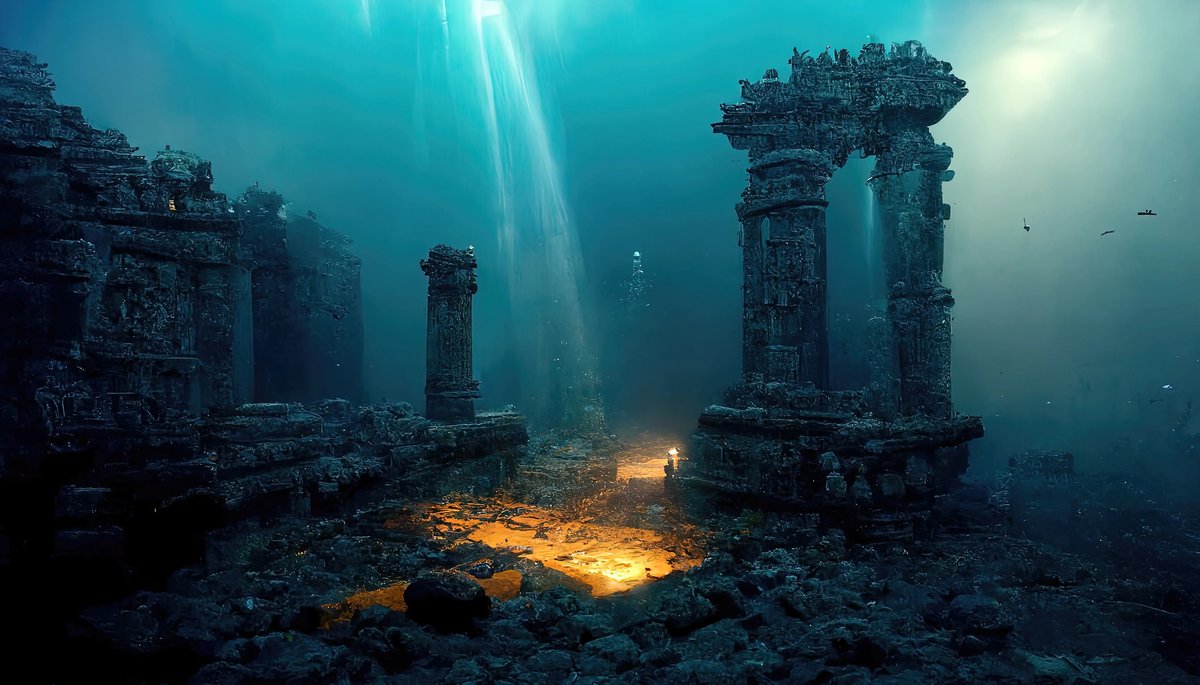
The whisper of a lost civilization, swallowed whole by the sea, has echoed through human history for millennia. Plato's tale of Atlantis – an advanced island empire beyond the Pillars of Hercules, consumed by a catastrophic day and night – isn't just a captivating story; it's a driving force behind real-world expeditions and the search for Atlantis, propelling daring explorers and rigorous scientists alike into the ocean's depths. This isn't just about finding a mythical city; it's about uncovering the dramatic truths of our planet's past and understanding humanity's enduring fascination with what lies beneath the waves.
At a Glance: Unpacking the Search for Atlantis
- Plato's Myth as a Catalyst: The Atlantis story, likely an allegory for imperial hubris, inadvertently jumpstarted the modern science of underwater archaeology.
- Real Submerged Cities Exist: While a literal Atlantis remains elusive, genuine discoveries like Helike, Doggerland, and ancient settlements in Aarhus Bay prove that entire civilizations have indeed been lost to the sea.
- Beyond the Sensationalism: Separating scientifically verified finds from speculative theories (like Lemuria or Mu) and media hype is crucial for understanding true archaeological progress.
- Technology is the Key: Advanced tools like sonar, 3D bathymetry, and AI are revolutionizing our ability to map and explore the ocean floor, bringing us closer to understanding drowned landscapes than ever before.
- A Deeper Meaning: The search for Atlantis isn't just about discovery; it reflects our anxieties about civilization, ecological disaster, and the profound impact of climate change on coastal societies, offering lessons for our future.
The Enduring Allure of a Drowned World
For more than two millennia, the saga of Atlantis has ignited imaginations. Picture it: an incredibly advanced island civilization, described by Plato around 360 BCE in his dialogues Timaeus and Critias. He spoke of an imperial power, formidable in its navy, boasting massive temples and cities laid out in concentric rings, all situated "beyond the Pillars of Hercules" – widely understood today as the Strait of Gibraltar. This mighty empire, after warring with ancient Athens, faced a sudden, dramatic end. In a single "day and night of misfortune," Plato recounted, it was swallowed by earthquakes and floods, vanishing beneath the waves.
Most historians today view Plato's account as an allegory, a philosophical commentary rather than a literal historical event. Perhaps it was a cautionary tale about imperial hubris, a vision of an ideal (or fallen) utopia, or even a cultural echo of ancient flood myths and forgotten civilizations. Regardless of its original intent, the story's vivid imagery of a technologically advanced society brought low by natural disaster and human folly has resonated across generations, embedding itself deep within our collective consciousness. It fuels not only curiosity but a profound, almost primal, desire to locate its remains.
From Legend to Logic: How Atlantis Sparked Underwater Archaeology
The profound dream of discovering Atlantis didn't just inspire armchair speculation; it inadvertently became a powerful catalyst for the birth of underwater archaeology in the 20th century. This burgeoning field transformed the romantic notion of finding a lost city into a systematic, scientific endeavor to explore the submerged past. Suddenly, the deep wasn't just a watery void but a potential museum, a hidden archive of human history.
The drive to find Atlantis spurred crucial advancements in exploration technologies. Early divers pushed the limits of their equipment, while engineers developed increasingly sophisticated tools like sonar mapping and remotely operated vehicles (ROVs). These innovations, born from a myth, laid the groundwork for how we study any submerged site today, from ancient shipwrecks to entire drowned cities. The pursuit of a legend created a scientific discipline, teaching us how to carefully excavate, document, and preserve treasures hidden for centuries. It's a clear example of how profound myths can lead to profound science, pushing the boundaries of what we know about the science of underwater archaeology.
Real "Atlantises" Beneath the Waves: Discoveries That Echo the Myth
While no definitive "Atlantis" has been found matching Plato's exact description, real-world expeditions have uncovered numerous genuine submerged cities, landscapes, and settlements that serve as powerful "Atlantean echoes." These discoveries aren't myths; they're tangible evidence of how our planet's shifting geology and climate have repeatedly claimed coastal societies, mirroring the catastrophic events described in Plato's tale.
Consider these incredible real-world examples:
- Helike, Greece: Often dubbed "the real Atlantis" by some, this ancient Achaean city was leveled by an earthquake and subsequently covered by a tsunami in 373 BCE – a catastrophic event strikingly similar to Plato's account, albeit on a smaller scale. Rediscovered in the early 2000s, Helike lies preserved beneath alluvial deposits near the modern coastline, offering a chillingly direct parallel to the Atlantis myth. Its sudden demise and preservation beneath layers of earth and water speak volumes about the vulnerability of coastal civilizations.
- Doggerland, North Sea: Imagine a vast, fertile land bridge that once connected Britain to continental Europe. This was Doggerland, a landmass that thrived with prehistoric human habitation, rich in flora and fauna. Then, around 10,000 years ago, as glaciers melted and sea levels rose dramatically, Doggerland was gradually swallowed by the North Sea. Modern reconstructions, based on extensive seafloor mapping and archaeological finds, paint a vivid picture of a truly lost world, a "continent" that simply vanished.
- Aarhus Bay Settlement, Denmark: Off the coast of Denmark, archaeologists have unearthed what's been called a "Stone Age Atlantis." This submerged Mesolithic settlement, dating back 8,000 years, offers an incredible time capsule of coastal life. Tools, hearths, and even preserved organic materials reveal how hunter-gatherers lived in a landscape that now lies dozens of meters beneath the waves. It's a poignant reminder of how dramatically coastlines have changed.
- The Bimini Road, Bahamas: Discovered in the 1960s, this peculiar underwater rock formation off North Bimini island consists of strikingly linear, rectangular limestone blocks. While many geologists contend it's a natural formation, its uncanny resemblance to an ancient paving or harbor structure has led some to speculate it could be an Atlantean harbor or remnants of a larger, submerged complex. The debate continues, keeping the spirit of speculative exploration alive.
- The Yonaguni Monument, Japan: Lying off the coast of Yonaguni Island, this massive, pyramid-shaped underwater structure with terraces and sharp angles looks undeniably man-made. Geologists largely consider it a natural geological formation, shaped by millennia of seismic activity and erosion. Yet, its striking appearance prompts ongoing debate and captures the imagination of those who believe it could be a submerged monument from an unknown ancient civilization.
- Sundaland & Sahul, Southeast Asia: During the last Ice Age, massive supercontinents like Sundaland (connecting parts of Southeast Asia) and Sahul (linking Australia and New Guinea) existed. These vast landmasses were home to prehistoric human populations for tens of thousands of years. As ice sheets melted, rising sea levels inundated these regions, submerging ancient coastlines, river valleys, and potential settlements. While not "lost cities," they represent monumental examples of vast, habitable lands that were truly swallowed by the sea, offering powerful insights into the impacts of climate change and sea-level rise.
These real discoveries underscore a profound truth: the Earth itself has many "Atlantean echoes." They are not Plato's Atlantis, but they are compelling evidence that civilizations, landscapes, and entire ways of life have indeed been lost to the sea, making the myth feel less like pure fantasy and more like a resonant memory.
The False Prophets and Fading Echoes: Separating Myth from Modern Speculation
The search for Atlantis, while inspiring genuine scientific inquiry, has also given rise to a fair share of speculative theories, media sensationalism, and outright hoaxes. It's crucial for any aspiring explorer or curious mind to learn how to distinguish between rigorous archaeology and popular fiction.
Take, for instance, the concepts of Lemuria and Mu. Postulated in the 19th and early 20th centuries, respectively, these hypothetical lost continents were said to span the Indian and Pacific Oceans. Lemuria was originally proposed to explain the geographical distribution of lemurs (before plate tectonics offered a better explanation), while Mu was popularized by James Churchward as the "Motherland of Man," a vast Pacific continent home to an advanced civilization. These ideas, often embraced by occult writers, sometimes depicted rival lost civilizations. However, unlike the Atlantean narrative which at least has a literary foundation, theories about Lemuria and Mu entirely lack scientific foundation. The very principles of plate tectonics preclude the existence of such massive, sunken landmasses in those ocean basins. They reflect a deeper human need to explain origins and a distant, imagined past, rather than any observable geological reality.
Then there's the pervasive issue of media sensationalism. Headlines scream "Atlantis Found – History Channel!" or "Atlantis Discovered 2025!" frequently based on ambiguous sonar scans or unverified claims. While these stories captivate audiences, they often contrast sharply with the meticulous process of official archaeology. True archaeological discoveries demand rigorous evidence, extensive peer review, and careful contextualization. A blurry image from sonar is not proof; it's a lead that requires years of painstaking research, diving, and analysis to confirm. Sceptics rightly view much of this as sensationalism designed for ratings, rather than a genuine contribution to our understanding of ancient civilizations and mythology. Critical thinking is paramount when engaging with any claims about lost cities.
The Tools of the Deep: How Technology Reshapes the Search
The modern quest for submerged history isn't just about daring dives; it's a high-tech endeavor, leveraging cutting-edge science and engineering to peer into the ocean's most inaccessible corners. These advancements bring the possibility of understanding Atlantis – or its real-world inspirations – closer than ever before.
Imagine the sheer power of these tools:
- Sonar Mapping (Multibeam Bathymetry): No longer just simple "pings," modern multibeam sonar systems create highly detailed, 3D topographical maps of the seafloor. They can reveal subtle anomalies, geometric shapes, and changes in the ocean bed that might indicate submerged structures or landscapes, providing the foundational data for identifying potential archaeological sites.
- 3D Bathymetry & Photogrammetry: Once a site is identified, advanced underwater cameras and laser scanners can capture thousands of images, which are then stitched together to create incredibly precise 3D models. These models allow archaeologists to "virtually" explore and study sites in unparalleled detail without disturbing delicate environments.
- Space-Based Remote Sensing: Satellites equipped with specialized sensors can sometimes detect subtle variations in sea level or even light penetration in shallow waters, hinting at submerged features. While limited to shallower areas, this global perspective offers a powerful reconnaissance tool.
- Muon Imaging (Cosmic Ray Muography): A more experimental technique, muon imaging uses cosmic rays to detect density changes within large structures, similar to an X-ray but on a massive scale. This could theoretically allow us to "see through" layers of sediment to detect hidden structures without excavation.
- AI Modeling and Data Analysis: Artificial intelligence is increasingly being used to process the vast amounts of data collected by sonar and other sensors. AI algorithms can identify patterns, anomalies, and potential structures much faster and more accurately than human eyes, helping to prioritize promising areas for further investigation.
These technologies are transforming ocean exploration. They allow us to map vast areas, penetrate sediment layers, and create virtual reconstructions of drowned landscapes. While they don't provide instant answers, they offer unprecedented capabilities for proving or disproving theories, and most importantly, for systematically uncovering the real-world stories hidden beneath the waves. This technological leap forward is rapidly changing modern ocean exploration technology.
Beyond the Legend: What the Search for Atlantis Truly Reveals
Ultimately, the quest for Atlantis transcends the hunt for a literal lost city. It mirrors profound human anxieties and offers a powerful lens through which to view our own vulnerability. Plato's narrative, with its advanced civilization brought low by nature's fury, resonates deeply with our contemporary concerns about high civilization, ecological disaster, and the existential threat of encroaching seas.
The myth of Atlantis echoes ancient Sumerian flood legends and countless other tales of cataclysm, illustrating how fundamental stories of human survival and loss spread across cultures, becoming part of our collective memory. It's a reminder of humanity's susceptibility to water, to geological forces, and to the consequences of our own hubris.
In an era defined by accelerating climate change and rising sea levels, the history of Atlantis increasingly sounds less like ancient fantasy and more like prescient foresight. We are currently witnessing the erosion of coastlines, the inundation of low-lying islands, and the threat to major coastal cities. The "Atlantean echo" is louder than ever, serving as a stark warning and a call to action. The myth compels us to confront our own relationship with the environment and consider the fragility of even our most robust civilizations. It emphasizes how myths don't just explain the past; they help us contextualize and prepare for the future, teaching us about the mystery of lost continents.
The Enduring Quest for What Lies Beneath
So, has Atlantis been found? In the definitive sense of Plato's descriptions, with its bronze walls and grand temples, no. Yet, the question itself might be too narrow. The real treasure of the search for Atlantis isn't a single archaeological breakthrough, but the continuous, often breathtaking, discovery of real submerged civilizations, drowned cultures, and landscapes that offer concrete evidence of humanity's deep and complex history with the sea.
From the earthquake-shattered ruins of Helike to the ancient, submerged plains of Doggerland, and the time-capsule Mesolithic settlements of Denmark, these tangible glimpses into our submerged past provide more than mere speculation. They highlight the undeniable, intimate link between myth and human memory, demonstrating how profound stories can both inspire scientific exploration and reflect the fundamental realities of our existence.
The journey continues, driven by human curiosity, advanced technology, and an unyielding desire to understand where we come from. The search for Atlantis represents a deeper quest—a fundamental human endeavor to piece together the narrative of our past, to comprehend how myths sustain our understanding of survival, and to unveil the untold chapters of history that lie hidden beneath the waves. It’s a compelling testament to the fact that while some mysteries may never be fully solved, the pursuit itself yields invaluable truths about our planet and ourselves. Your next step into the mystery of drowned worlds awaits with our comprehensive Journey to Atlantis guide.